


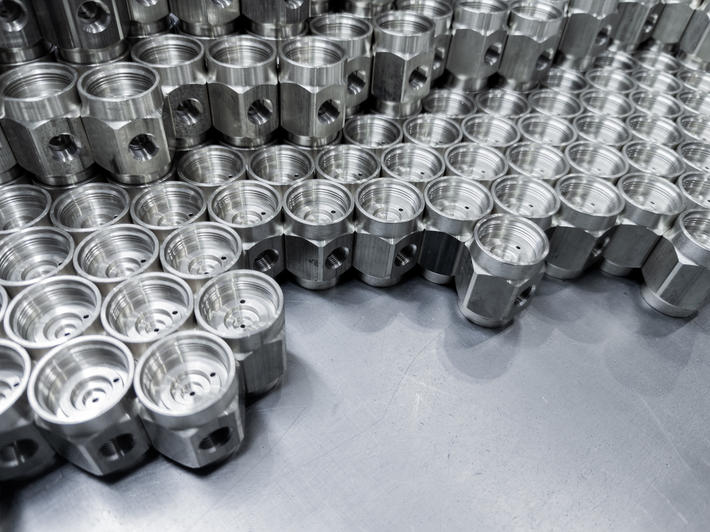
When Precision Is Non-Negotiable: Aluminum Die-Cast Medical Components
A medical device or diagnostic instrument leaves no margin for error: each component must meet tight tolerances, maintain its characteristics over time, and pass rigorous tests before being used.
In this context, aluminum medical components obtained by die casting meet a specific requirement: combining dimensional precision, mechanical stability, and surface quality in a single production process.
Why Aluminum in Medical Devices
Aluminum for medical devices is chosen for a combination of characteristics that are well-suited to the needs of the industry:
- it is lightweight, making it easier to handle instruments and equipment;
- It has good dimensional stability, important for parts that must maintain precise tolerances over time;
- It lends itself to surface treatments and finishes compatible with clinical environments.
Die casting, for its part, allows for complex geometries to be achieved in a single casting, reducing the number of machining operations and parts to be assembled – a significant advantage when component repeatability is a key requirement.
Typical Applications of Medical Die Casting
Medical die casting is used in a range of applications that share the same requirement for reliability:
- Mechanical arms and joints for dental instruments;
- Structural parts for surgical robotics systems;
- Components of clinical support devices;
- Structural elements of diagnostic instruments and specialized equipment.
In all these cases, the die-cast component is never an isolated element: it is part of a larger mechanical or electromechanical system, where dimensional accuracy and surface quality directly affect the function and safety of the final instrument.
What a die-cast component for medical use requires
Compared to other sectors, the medical industry requires an additional level of attention throughout the entire process: from alloy selection to mold design, dimensional checks, and surface finishes, each step must be traceable and consistent with the specifications required for the final device.
It's a field in which collaboration between the part designer and the manufacturer becomes crucial from the earliest stages of development, to prevent a manufacturing detail from becoming a problem during validation or clinical use.
A single point of contact for aluminum medical components: Italpres
For those developing medical devices or diagnostic instruments, being able to rely on a single supplier for part and mold co-design, casting and finishing simplifies control of each phase and reduces variability between processing steps. Italpres offers this integrated production model, also applicable to projects requiring the precision levels typical of the medical sector.
Do you have a die-cast aluminum component to produce for a medical device or diagnostic instrument? Talk to our team.