


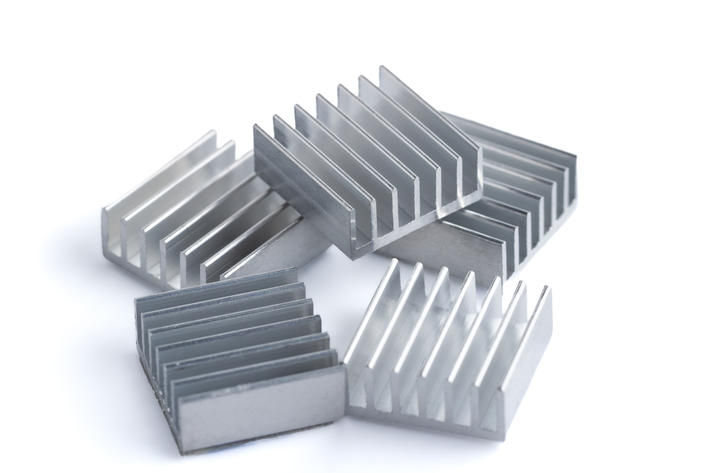
Aluminum Heat Sinks and Lamp Housings: Die-Casting for Lighting
A LED fixture that loses brightness after a few months, or that shuts down prematurely, almost always has the same culprit: heat that can't escape from the chip quickly enough. In solid-state lighting, thermal management isn't a secondary technical detail, but the difference between a durable product and one that degrades. And it's precisely on this front that die-cast aluminum heat sinks have established themselves as the benchmark solution, along with the lamp housings and housings that integrate them.
Why is aluminum the ideal material for heat dissipation?
High-density LED arrays generate heat that must be quickly dissipated from the joint. If this isn't done, the luminous flux drops and the component's lifespan is shortened. Aluminum heat sinks meet this requirement well for a simple reason: aluminum alloys conduct heat efficiently, weigh less than other structural metals, and resist corrosion well—a combination difficult to find elsewhere at comparable costs.
Added to this is a process advantage: die casting allows cooling fins, mounting bosses, cable glands, and gasket housings to be integrated into a single casting, elements that would otherwise require more machining and assembly.
Where is an aluminum heatsink used for LEDs?
This combination of properties makes the aluminum heatsink for LEDs the most popular choice in a wide range of applications:
- Lighting fixtures and downlights for residential and commercial use;
- Street and architectural lighting fixtures;
- Floodlights and spotlights for outdoor, industrial, or highly exposed areas;
- Enclosures and housings for control panels and signaling equipment, where the heatsink also serves as a protective casing.
In all these cases, the part must combine multiple requirements – thermal performance, corrosion resistance, weight reduction, often complex geometry – and this is exactly the kind of balance that high-pressure die casting can ensure in large volumes and with good repeatability.
From casting to ready-to-assemble component
A heat sink body fresh from the mold is not yet a finished component. It generally requires mechanical reworking of the mating surfaces and holes, a surface treatment (anodizing or painting, depending on the intended use and exposure to external agents), and, in many cases, a dimensional check to ensure durability and compliance with the design. This process must be planned from the outset with the customer, because the choices made during the part and mold design phase directly influence the quality and costs of all subsequent phases.
The value of a single point of contact throughout the entire supply chain
For lighting fixture manufacturers, relying on multiple suppliers for casting, machining, and finishing means increasing coordination points and the risk of supplier variance.
Italpres manages the entire process as a single point of contact. From co-design of the part and mold, to die casting, machining, and finishing, we are always at the customer's side, guaranteeing quality and control at every stage of production.
Our approach is designed for those in the lighting industry who need a partner capable of following the heat sink or lamp body from the initial design to the finished piece, seamlessly along the supply chain.
Want to develop an aluminum heat sink or lamp body? Contact Italpres to find out how.