

Automotive Die Casting: The Advantages of Aluminum for Auto Components
A lighter car consumes less, pollutes less, and—in the case of an electric vehicle—travels more miles with the same battery. It's one of the simplest equations in the automotive industry, but translating it into real, reliable, and mass-produced components is anything but trivial.
This is where aluminum automotive die casting has found its niche: a technology capable of combining lightness, mechanical strength, and large production volumes, becoming over the years one of the most concrete solutions to the industry's needs.
Why Aluminum Is the Material of Choice in Automotive
The starting point is the material. Aluminum for automotive applications offers a strength-to-weight ratio that few other metals can match: it weighs less than steel, resists heat and corrosion well, and is recyclable without losing its mechanical properties.
For manufacturers and suppliers who need to reduce fuel consumption and emissions without compromising safety and durability, it has gradually become the go-to material for a wide range of components—from engine mounts to gearboxes to various structural chassis parts.
From material to process: what's new with die casting
Having the right material isn't enough: you need a process capable of transforming it into precise, repeatable parts produced in large quantities. This is where die casting makes the difference.
- Lightweight components without sacrificing strength
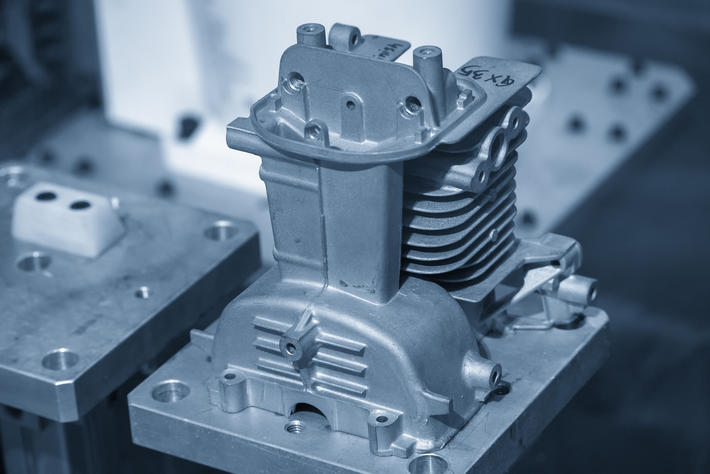
Die casting allows for the production of thin-walled yet structurally solid aluminum automotive components – a combination difficult to achieve with other metalworking techniques. The result is a lighter component without compromising strength and reliability, a non-negotiable requirement when it comes to parts that must guarantee long-term safety.
- Precision and repeatability at large volumes
The real leap in quality comes when moving from single parts to series production. The same mold can generate thousands of nearly identical castings, with tight tolerances and minimal need for subsequent processing. This is a crucial feature for an industry like the automotive industry, where volumes are high and every part must meet the same specifications, without exception.
- Greater design freedom, fewer parts to assemble
This same precision also opens up other possibilities: die casting allows complex geometries to be created in a single casting, integrating functions into a single component that would otherwise require multiple separate parts. Fewer parts mean fewer assembly operations, fewer critical points, and fewer steps along the production line—with direct benefits in terms of time and costs.
- A material that lends itself to sustainability
Finally, an aspect that is increasingly weighing on the choices of manufacturers and suppliers: aluminum can be recycled repeatedly without losing the properties that make it suitable for automotive use. In a scenario where the environmental footprint of production processes is increasingly under scrutiny by the entire supply chain, this characteristic is not a marginal detail, but rather an additional reason to continue choosing this material and this technology.
From casting to finished component: why the process doesn't stop with die casting
A die casting, no matter how well executed, is not yet a component ready for installation on a vehicle. It requires precision machining, finishes appropriate for the intended use, and—before all else—co-design between customer and supplier that takes into account mold and production requirements from the design stage. This is the point at which the quality of the chosen partner is as important as the quality of the material.
Italpres manages the entire production cycle as a single point of contact: from co-design of the part and mold, to casting in aluminum and zinc-aluminum alloys, to machining, finishing, and assembly. A process designed for sectors—including the automotive sector—where reliability, precision, and continuity throughout the supply chain make the difference between a supplier and a true production partner.
Do you have an aluminum automotive component to develop? Contact Italpres to discuss it with our team.