


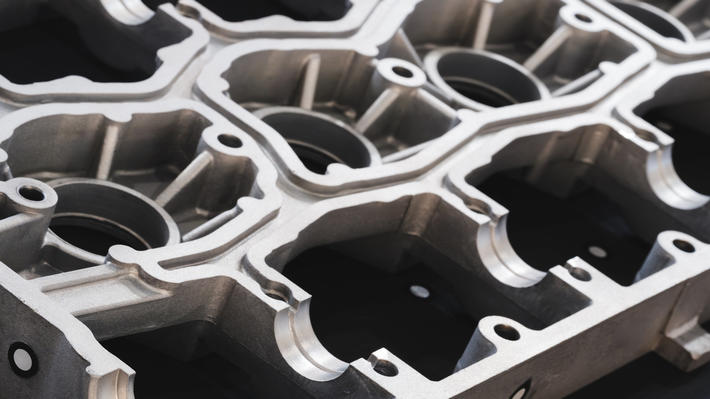
Heat treatment of aluminum die-casting: results of a university study on the optimization of HPDC castings made from recycled AlSi10Mg alloy
Introduction: Sustainability and recycled aluminum alloys in the automotive industry
Reducing the global warming potential of vehicles has become a growing priority for the automotive industry. Manufacturers are aiming to reduce greenhouse gas emissions through the transition to battery-electric vehicles, reducing vehicle mass, and adopting sustainable materials.
In this context, demand for aluminum alloys has increased significantly due to their lightweight nature, which allows for reduced vehicle mass, lower CO2 emissions, increased range, and lower fuel costs. The use of recycled lightweight alloys is essential for improving overall sustainability by reducing the need for new raw materials—an energy-intensive and polluting process.
Recycled aluminum alloys today offer high mechanical properties, comparable to those of primary alloys, while requiring only 5% of the energy needed to produce aluminum from ore. However, their use presents some challenges: impurities such as iron can compromise mechanical properties and corrosion resistance, a particularly critical aspect for safety components. Iron can form needle-like or lamellar intermetallic compounds, negatively impacting the strength and durability of components. To improve casting quality, manganese is often added to modify the morphology of these compounds, although this introduces the risk of sludge formation.
A widely used alloy to produce lightweight, high-strength components for the automotive industry is AlSi10MnMg, widely used in HPDC die casting processes due to its excellent castability, high mechanical properties, and remarkable corrosion resistance.
The Role of Heat Treatment of Aluminum Die-Casting
The heat treatment of aluminum die-casting plays a critical role in the production of aluminum components, requiring significant energy and impacting the environmental impact of castings. Castings made from Al-Si-Mg alloys are traditionally subjected to heat treatments such as T5, T6, T7, and annealing.
The T6 treatment, consisting of three long-term phases, requires significant energy consumption—high temperatures and prolonged times during the solution annealing and aging phases—and significant logistics costs. For environmental and economic sustainability reasons, automotive companies are seeking to replace the T6 treatment with alternative treatments such as T5 (artificial aging) and high-temperature stress relief, aiming to find the best compromise between mechanical strength and elongation at break.
To increase resistance to environmental corrosion, automotive components are typically subjected to painting, anodizing, and coatings, particularly e-coating, a highly efficient and environmentally friendly post-processing technology widely used in the automotive industry for coating frames and components.
Research Objective and Methodology
Recent research conducted at the University of Brescia focuses on understanding and optimizing heat treatments to improve the mechanical, electrical, and thermal properties of aluminum alloys with a high recycled content. The analysis was conducted on an automotive structural component made from recycled AlSi10MnMg alloy produced by HPDC die casting.
Material characterization included a wide range of analyses: optical and electron microscopy, Brinell hardness tests, tensile tests at room temperature and high temperature (130°C), flexural tests, SPR riveting tests, and electrical and thermal conductivity tests.
Brinell Hardness Test Results
The lowest aging temperatures tested (150°C, 170°C, and 190°C) showed a gradual increase in hardness with increasing treatment time, up to 180 minutes. This behavior is attributed to the progressive precipitation of hard phases in the material, as dissolved elements diffuse and form secondary phase particles (Mg3Si) within the metal matrix, increasing hardness. The plateau observed at these temperatures is caused by overaging, which occurs when the precipitates grow excessively and begin to coalesce.
At higher aging temperatures (210°C and 230°C), overaging occurs more rapidly, already after 2 hours, suggesting that increasing temperature accelerates the process but also causes a decrease in the maximum achievable hardness.
At high annealing temperatures, hardness tends to decrease with increasing treatment time, a phenomenon related to material recrystallization and grain growth. Although annealing treatments show a reduction in hardness, they can improve other properties such as ductility and the reduction of internal stresses.
Based on these results, the conditions selected for further investigation were:
- As-produced condition, studied as a reference;
- E-coating simulation at 163°C for 20 minutes;
- Aging at 170°C for 180 minutes, the optimal combination for achieving maximum hardness;
- Aging at 210°C for 180 minutes;
- Annealing at 380°C for 180 minutes, to achieve minimum hardness and promote maximum elongation.
Microstructure after heat treatments
Microscopic analysis revealed significantly different behaviors depending on the treatment applied.
For the e-coating conditions (163°C for 20 minutes), aging at 170°C, and aging at 210°C, the microstructure shows no significant alterations compared to the as-produced condition: the aluminum dendrites, intermetallic particles, and eutectic silicon maintain essentially unchanged morphology and distribution. Any improvements in mechanical properties under these conditions are attributable to the precipitation of Mg3Si particles, which are not detectable at these magnifications.
The annealing treatment at 380°C for 3 hours, however, produces a radical microstructural change: the aluminum dendrites become finer, and the spheroidization of the eutectic silicon particles is clearly observed, taking on a more spherical and regular shape compared to the initial condition. This phenomenon is directly responsible for the significant improvement in ductility observed in subsequent mechanical tests.
Room-Temperature and High-Temperature Tensile Tests
The room-temperature tensile tests showed trends consistent with the hardness test results. Aging at 170°C for 180 minutes produced the highest strength values, with a significant increase in yield strength compared to the as-produced condition, but with a reduction in elongation. Aging at 210°C showed slightly lower strengths than 170°C but still higher than the as-produced condition. Annealing at 380°C, on the other hand, produced the lowest strength and yield strength values, but these were offset by a significantly higher elongation than all other conditions.
In high-temperature tests (150°C), the material retained almost all of its original tensile strength, undergoing only a slight reduction in average UTS. The 380°C for 180 minutes test proved to be the most effective in increasing ductility, bringing the elongation to 25%, a 61.3% improvement compared to the same test conducted at room temperature.
Fracture surface analysis revealed mixed surfaces characterized by dimples and cleavage planes for the as-produced, e-coated, and T5 conditions. In the samples annealed at 380°C for 3 hours, the dimples were generally larger, nearly round, and deeper, indicating greater deformability and a coarser microstructure.
Bending Tests
Bending tests provided precise quantitative data on the average bend angles achieved by each test condition. According to automotive standards for premium car production, the desired bend angle for Al-Si alloys with thicknesses greater than 2 mm must be greater than 50°.
The results show a clear hierarchy among the treatments:
- As-produced: average angle of 26.9°, elongation of 7.6%;
- E-coating 163°C - 20 min: average angle of 23.5°, elongation of 6.6%;
- Aging 170°C - 3 hours: average angle of 15.8°, elongation of 5.8%;
- Aging 210°C - 3 hours: average angle of 19.1°, elongation of 5.5%;
- Annealing at 380°C - 3 hours: mean angle of 52.1°, elongation of 15.5%.
Only annealing at 380°C for 3 hours exceeded the required threshold of 50°, with the highest value of all the conditions tested and the lowest standard deviation (1.7°), demonstrating greater consistency and repeatability of the results. All other treatments remained significantly below the regulatory threshold, confirming that this treatment is the only one suitable for automotive applications requiring high ductility and bending resistance.
The annealing treatment significantly improved the microstructure, alleviating internal stresses resulting from the HPDC process, spheroidizing the silicon particles, and increasing the material's plastic deformation capacity, resulting in improved energy absorption and more uniform stress distribution.
SPR Riveting Test
Visual inspection of the SPR riveting test yielded negative results for the as-produced, e-coating, and T5 aging conditions, in which cracks were observed, revealing significant process issues. Annealing at 380°C significantly improved the microstructure, increasing ductility and reducing crack propagation thanks to the reduction of internal stresses and the spheroidization of the silicon particles. Of the five conditions tested, it was the only one to fully meet automotive standards, demonstrating no cracks or deformations and high ductility during the riveting process.
Electrical and Thermal Conductivity
The electrical conductivity values obtained fall within the standard range reported in the literature for the alloy under consideration (16-25 MS/m). At low aging temperatures (170°C), electrical conductivity increased by 4% compared to the as-produced condition. At higher temperatures, silicon particles tend to grow and decrease in number, increasing conductivity by 18% at 210°C for 3 hours and by 30% at 380°C for 3 hours. The silicon spheroidization process observed at these conditions further improved conductivity by reducing electron diffusion.
For thermal conductivity, an increase was observed with increasing temperature: at 35°C, thermal conductivity was approximately 117 W/(mK), increasing to approximately 129 W/(mK) at 150°C, with some nonlinear fluctuations along the curve.
Conclusions and Application Recommendations
Based on the results obtained, the following recommendations can be made for aluminum HPDC castings based on application requirements:
- As-produced condition: Recommended when the primary objective is to reduce production costs and environmental impact while maintaining the good performance levels typical of HPDC-produced AlSi10MnMg alloys. Ideal for applications with less stringent performance requirements.
- E-coating at 163°C for 20 minutes: Does not induce significant changes in mechanical properties, but can be applied when automotive specifications require
greater corrosion resistance. It is also suitable for previously heat-treated parts.
- Aging at 170°C for 3 hours: Recommended for applications requiring high yield strength, significantly improving mechanical properties without compromising other critical characteristics. Particularly suitable for components that must maintain structural integrity under high loads but do not require riveting or high ductility.
- Annealing at 380°C for 3 hours: Offers the most advantageous combination of mechanical properties, electrical and thermal conductivity, ductility, and joint strength. With an average bend angle of 52.1° and an elongation of 15.5%, it is the only treatment that meets premium automotive standards for flexure and is the only one to guarantee no cracks in riveting tests. Particularly suitable for applications such as electric vehicle battery casings, heat exchangers, transmission covers, oil pumps, and cylinder head covers, typically produced in Al-Si alloys using HPDC die casting.
Source: Università di Brescia and In Fonderia – Il magazine dell’industria fusoria italiana