

Engineering in Die Casting: Why Involve the Caster Before the Final Design
A technical drawing can be flawless on paper but prove problematic as soon as you try to transform it into a die casting mold. Undercuts that prevent part removal, walls that are too vertical, sections that are much thicker than others that cool unevenly: these are design flaws that emerge late, when modifying them costs time and money. Engineering in die casting was born precisely to avoid this scenario, bringing the experience of those who build and use the mold into the part co-design phase, before it becomes definitive.
What does it mean, in practice, to design together?
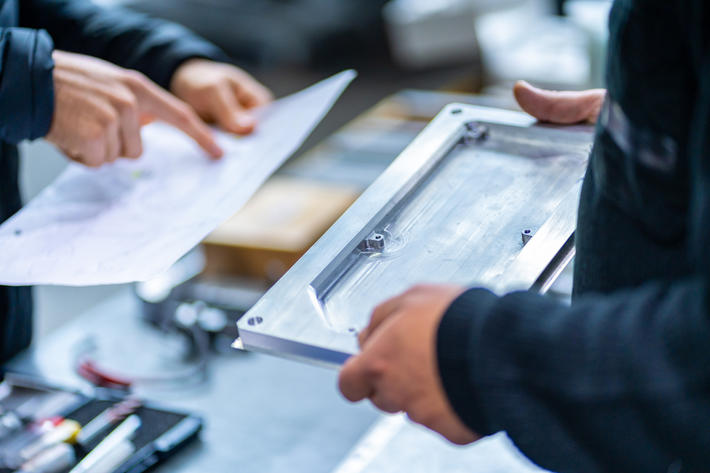
Co-design in die casting is not a formal review of the customer's drawing, but rather a shared design of the molds between the component designer and the mold and casting manufacturer. This phase determines the aspects that directly influence the feasibility of the molding: the presence of undercuts, the draft angles required to extract the part without damaging it, the thickness distribution to avoid uneven cooling, and the weight and pressure required by the mold based on the part's geometry.
These are considerations that require specific molding skills, not just mechanical design. This is where engineering in die casting makes the difference compared to a design conceived without consulting the person who will then translate it into a functioning mold.
Why it's better to do it sooner, not later
Putting this comparison on until the mold is already under construction—or worse, until the mold is finished—means discovering problems at the most costly time to fix them. A defect identified in the drawing can be corrected with a CAD modification; the same defect identified on a mold already machined often requires a tooling overhaul, wasting time and budget. Involving the caster in the co-design phase of the aluminum mold allows these problems to be identified while it's still relatively inexpensive to fix them, and allows the mold to be built with a design that has already been verified for production feasibility.
The advantage of having design and production under one roof
When the part is co-engineered with a supplier that has its own in-house technical department, the comparison between the design and production feasibility doesn't involve an external contact: changes are discussed and evaluated directly with the mold maker, reducing the back-and-forth times typical of a design divided between multiple parties.
This is the model on which Italpres has built its aluminum die-casting mold co-design department since its inception: dedicated technical staff, constantly updated work tools, and the ability, when necessary, to work on existing or customer-owned equipment. This approach allows mold engineering to be approached not as a separate step, but as an integral part of the process from design to finished component.
You can find all the details about the service on the dedicated page.
Do you have a project you'd like us to evaluate before finalizing the design? Contact us.